


Expertise


From the early pioneers on the Snowy Mountains Hydroelectric Scheme, to our leaders and innovators of today, our people make us who we are.
Through our network of global specialists and by collaborating with local partners, we connect you with the best teams and capabilities to deliver highly innovative and sustainable solutions.
As an organisation we are continually evaluating ways we can better provide a safe, flexible, inclusive and respectful workplace for our people and clients.
People are at the heart of our organisation, we strive to create a flexible, diverse and inclusive environment that enables our people to thrive to their fullest potential.
Explore career opportunities
Global air travel is projected to more than double between 2024 and 2050. Over the same period the aviation sector will need to abate approximately 1.8 gigatonnes of CO₂ annually to accommodate growing demand while meeting net zero commitments. This gap between growth and emissions reduction is structural. It cannot be closed by fleet renewal or operational efficiency alone and requires solutions that can be deployed at scale within existing aircraft and fuel systems.
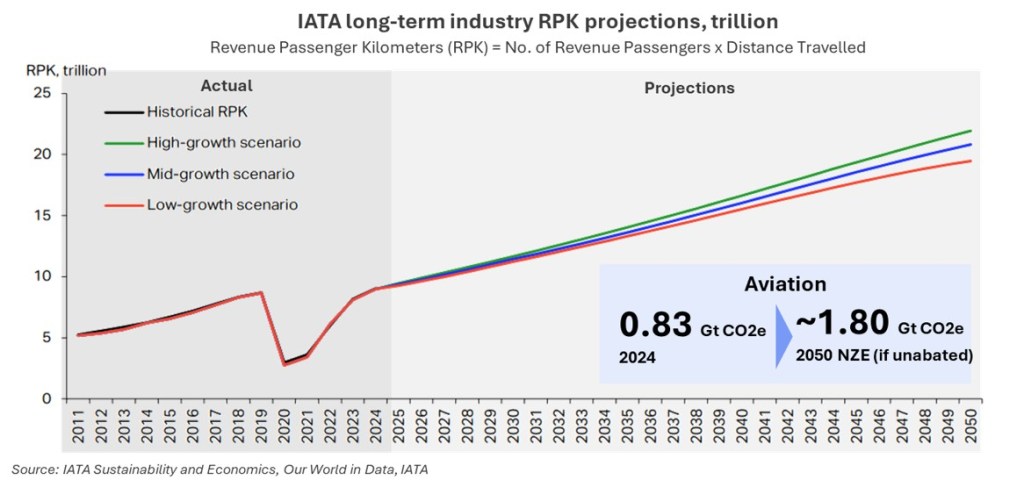
Sustainable Aviation Fuel (SAF) has emerged as the most viable near-term pathway for aviation decarbonisation because, unlike alternative propulsion technologies, SAF can be used within current aircraft, engines and fuel infrastructure, enabling immediate emissions reduction without disrupting global aviation systems.
While SAF has been discussed for almost two decades, its role has expanded. It is no longer driven solely by environmental objectives but increasingly by energy security and fuel supply resilience, particularly in the context of geopolitical volatility and fuel price uncertainty.
Despite this momentum, SAF continues to command a significant premium over conventional Jet A‑1 fuel. Current pricing is typically two to five times higher, depending on feedstock, technology pathway and geography. As a result, widespread adoption remains highly dependent on policy mechanisms such as blending mandates, carbon pricing, incentives and long-term offtake structures.
Globally, clearer demand signals are now taking shape. Regulatory frameworks and national mandates are acting as push factors, while incentives and public commitments are creating pull.
In Europe, the ReFuelEU Aviation initiative mandates a SAF blend of approximately 2 percent from 2025, rising progressively to 70 percent by 2050. Other jurisdictions are following with similar approaches aligned to International Civil Aviation Organization (ICAO) and Carbon Offsetting and Reduction Scheme for International Aviation (CORSIA) frameworks. Transparency around feedstock pricing, cost of production and project economics is also becoming a decisive factor for investors and financiers, shaping capital allocation and deployment strategies.
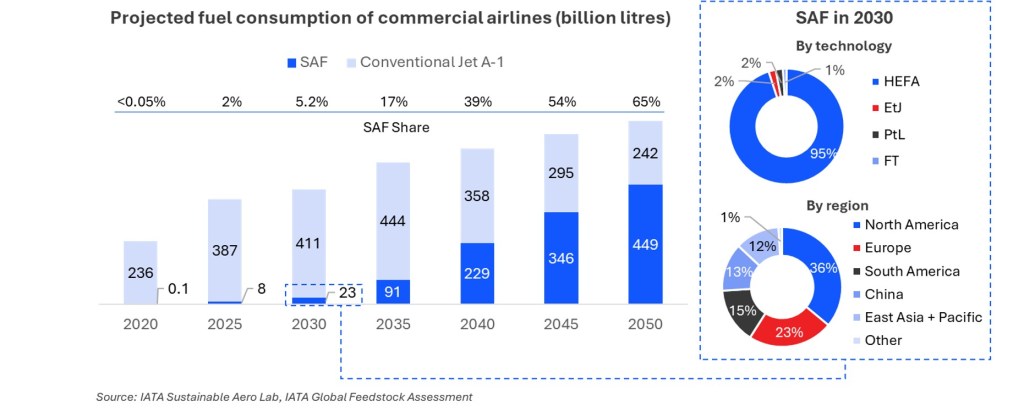
Today, the majority of SAF projects that have reached final investment decision are based on the Hydroprocessed Esters and Fatty Acids (HEFA) pathway, supported by mature technology, established American Society for Testing and Materials (ASTM) certification and availability of waste oil and lipid-based feedstocks. HEFA is expected to dominate deployment over the next five years.
However, reliance on a single pathway introduces long-term risk, so alternative technologies offer important diversification opportunities, including:
All pathways currently face ASTM blend limits of 50 percent, with work underway to enable higher blends and fully formulated fuels. These technical and regulatory realities must be incorporated early in project design.
Certification introduces additional complexity that directly influences engineering decisions. Technical certification under ASTM D7566 ensures engine compatibility, while sustainability certification through schemes such as ISCC, CORSIA and Roundtable on Sustainable Biomaterials (RSB), validates lifecycle emissions performance, traceability and sustainability compliance. Without these certifications, SAF cannot enter the aviation fuel market.
Logistics and blending considerations are equally critical. Decisions around co‑processing in conventional refineries versus dedicated biofuel facilities with downstream terminal blending have direct implications for storage, segregation, quality assurance and airport integration. Engineering design that integrates logistics and blending requirements from the outset significantly reduces delivery and operational risk.
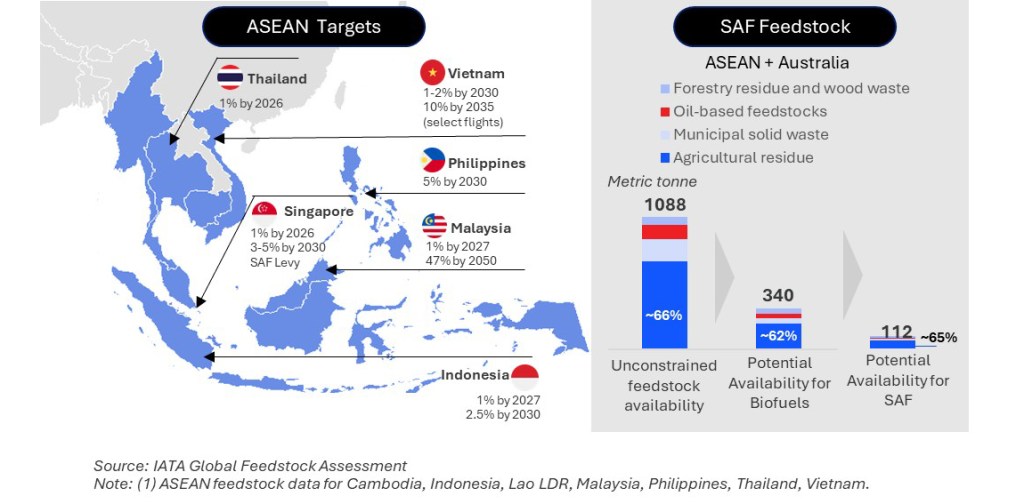
ASEAN plays a strategically important role in the global SAF landscape, with several countries in the region announcing national targets in recent years.
Singapore has introduced a SAF levy from 2026 that will rise through the next decade, while Indonesia, Thailand, Malaysia, Vietnam and the Philippines have also announced blending targets or policy intentions extending to 2030 and beyond.
Critically, approximately 65 percent of unconstrained global SAF feedstock potential is located in ASEAN and Australia, largely in the form of agricultural residues, forestry waste and municipal solid waste, creating a strong supply side foundation for scaled production.
In Southeast Asia, near term deployment is expected to be dominated by HEFA due to abundant oil-based feedstocks and technology maturity, while medium to long-term growth is expected to be driven by agricultural residues via cellulosic ethanol, gasification and Fischer Tropsch pathways.
Electro fuels may provide future renewable energy export opportunities for countries with strong renewable endowments, although techno-economic feasibility remains sensitive to rising electricity demand from other sectors, including data centres.
Recent SJ Group project delivery experience highlights the practical realities of scaling SAF, including a 350,000 tonne per annum biofuel production facility in Johor, Malaysia, which produces SAF, Hydrotreated Vegetable Oil and Bio Naphtha using waste derived feedstocks such as used cooking oil and palm oil mill effluent. Despite a highly compressed engineering and procurement schedule, the project was successfully commissioned through:
The project demonstrates that, while SAF technologies may be well understood, delivery complexity often lies in coordination, integration and governance.
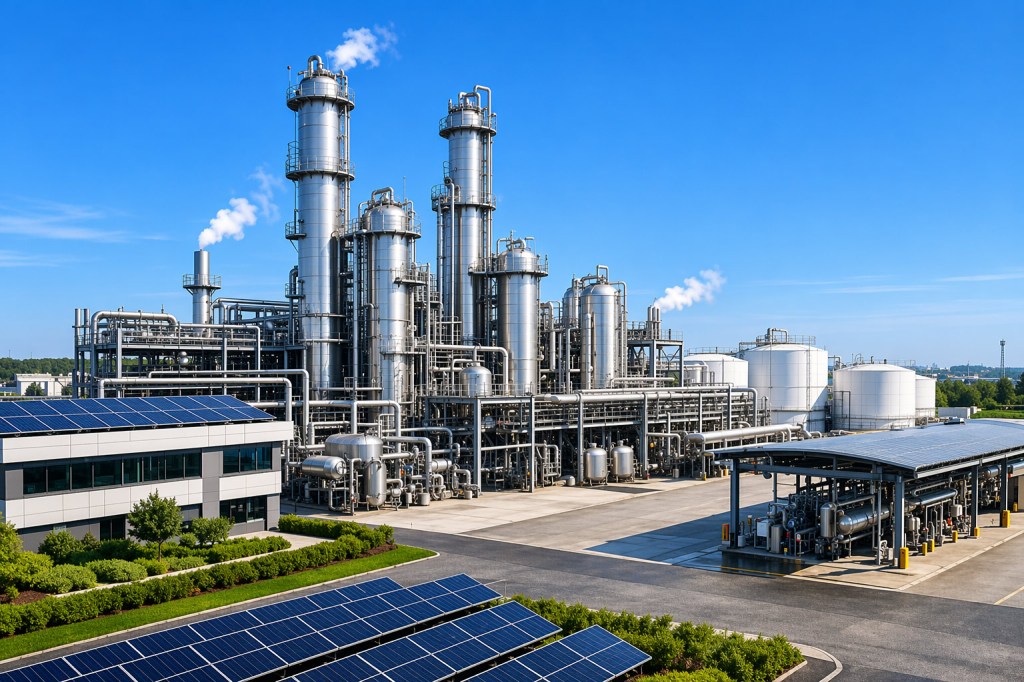
Ultimately, the transition from ambition to delivery will be defined by engineering capability, particularly in the early stages where decisions have the greatest leverage on cost, schedule and risk.
Early-stage engineering reduces risk through integrated analysis of feedstock availability, sustainability performance, logistics, economics and policy alignment, supported by core capabilities such as techno- economic assessment, lifecycle carbon analysis, process integration and programme management that underpin operational reliability and financial viability.
To decarbonise aviation at scale, the sector will need more than commitment, with disciplined engineering, strong project governance and collaboration across policymakers, producers, airlines and financiers all required to translate targets into bankable, deliverable projects.
Sustainable aviation fuel can deliver meaningful emissions reductions today, but only if ambition is matched by execution.
As the world pushes toward net-zero targets, the development of renewable energy infrastructure is a critical part of the solution. In Australia, renewables supplied 40% of the country’s total electricity in 2023, an increase of almost 10% in a single year.
In this series, we share how our team is unlocking a smoother pathway for approvals, community engagement and environmental planning for many of our renewable energy clients around the world.
This paper presents a comprehensive methodology for designing and modelling Green Hydrogen Systems developed by Surbana Jurong (SJ) and SMEC, known as S2H2. The methodology integrates traditional systems engineering with innovative elements to optimise performance, reliability, and sustainability across the entire project lifecycle.