


Expertise


From the early pioneers on the Snowy Mountains Hydroelectric Scheme, to our leaders and innovators of today, our people make us who we are.
Through our network of global specialists and by collaborating with local partners, we connect you with the best teams and capabilities to deliver highly innovative and sustainable solutions.
As an organisation we are continually evaluating ways we can better provide a safe, flexible, inclusive and respectful workplace for our people and clients.
People are at the heart of our organisation, we strive to create a flexible, diverse and inclusive environment that enables our people to thrive to their fullest potential.
Explore career opportunities
Mechanical equipment and architectural design choices together set the baseline for data centre energy consumption. On the mechanical side, cooling plant typically has the greatest influence beyond the IT load itself, with chillers, cooling towers, pumps, fans, control sequences and heat rejection strategy all shaping how much non-IT power is required to maintain thermal stability. Cooling infrastructure is often one of the largest facility energy consumers, which means equipment selection, redundancy philosophy, variable speed control, containment strategy and part load efficiency have a direct effect on PUE (power usage effectiveness) and whole of life performance.
Architectural building design is equally influential because the envelope, orientation, glazing levels, roof reflectivity, insulation, airtightness and internal spatial arrangement determine external heat gain, air leakage and how effectively airflow can be managed within white space and support areas. A whole building approach therefore becomes critical: the building form, façade and plant arrangement must be designed together so that thermal loads are reduced at source before they are met by mechanical systems.
Power architecture also cannot be considered in isolation. Cooling load, heat rejection strategy, water availability, and target PUE all shape system sizing, efficiency, resilience, and site selection. In practice, energy infrastructure and facility design are now closely intertwined.
In many regions, including remote locations, emerging markets, and areas with constrained networks, the grid is either unavailable or unable to support the required scale, redundancy, or delivery timetable. As a result, grid-independent operating models and islanded data centres are becoming a strategic infrastructure solution rather than a contingency option.
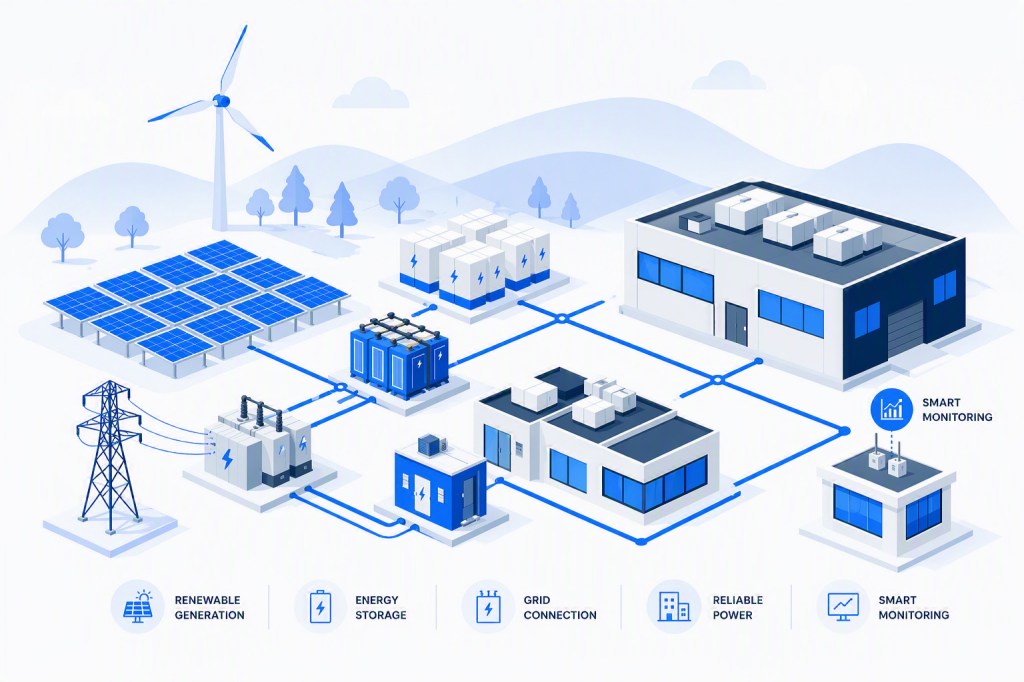
A grid–independent data centre should therefore be engineered as a complete energy ecosystem, not as a conventional facility with backup generation added on. The system extends well beyond the data halls to include on-site or nearby generation assets, energy storage systems, medium voltage collector networks, system stability equipment, communications, and digital delivery platforms. Each element needs to be designed as part of an integrated whole, with a clear understanding of power flows, failure response, and how the system will evolve over time.
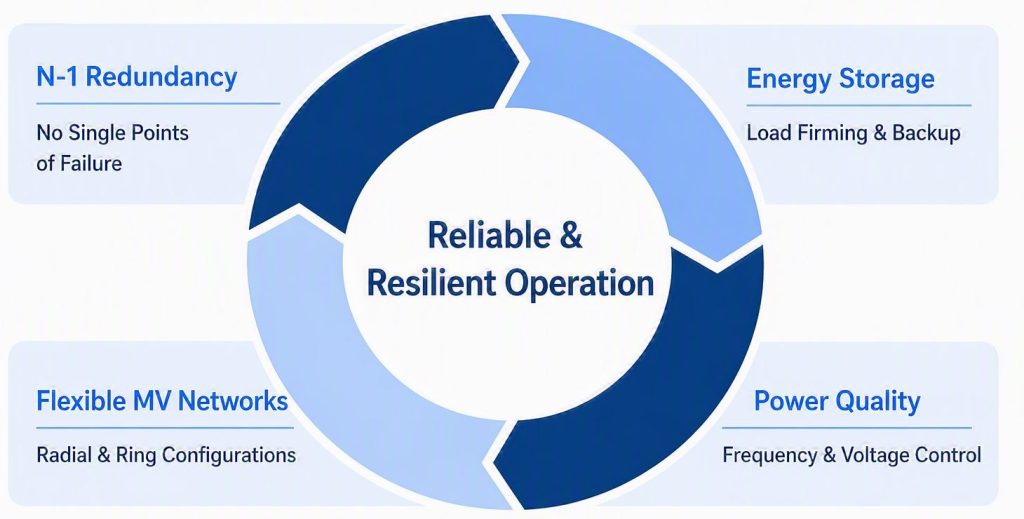
High availability targets, often aligned with concurrently maintainable design expectations, are now common across mission critical digital infrastructure. In a grid-independent environment, achieving this level of performance depends on deliberate engineering and architectural choices rather than reliance on external system strength or network diversity. Reliability must be built into the electrical topology from the outset, with clear identification and management of single points of failure across generation, storage, switching, and distribution assets.
Medium voltage infrastructure forms the backbone of the grid-independent data centre system. Collector networks, typically operating in the 11 to 66 kV range depending on capacity and local standards, connect generation, battery energy storage systems, and data centre loads through switching stations and ring main units. Whether the network is configured as radial, ring, or hybrid has a direct effect on redundancy, maintainability, and operational flexibility. Designing to eliminate a single point of failure (N-minus-one) at the medium voltage level allows individual feeders, power conversion units, or substations to be isolated without interrupting supply to critical loads.
Early-stage failure mode and effects analysis helps identify credible failure scenarios before equipment selection is finalised. This allows redundancy to be targeted where it delivers genuine availability benefits, while avoiding unnecessary duplication that adds cost and operational complexity without improving outcomes. At the same time, the design should retain enough flexibility to accommodate future options as equipment specifications and operating profiles become clearer.
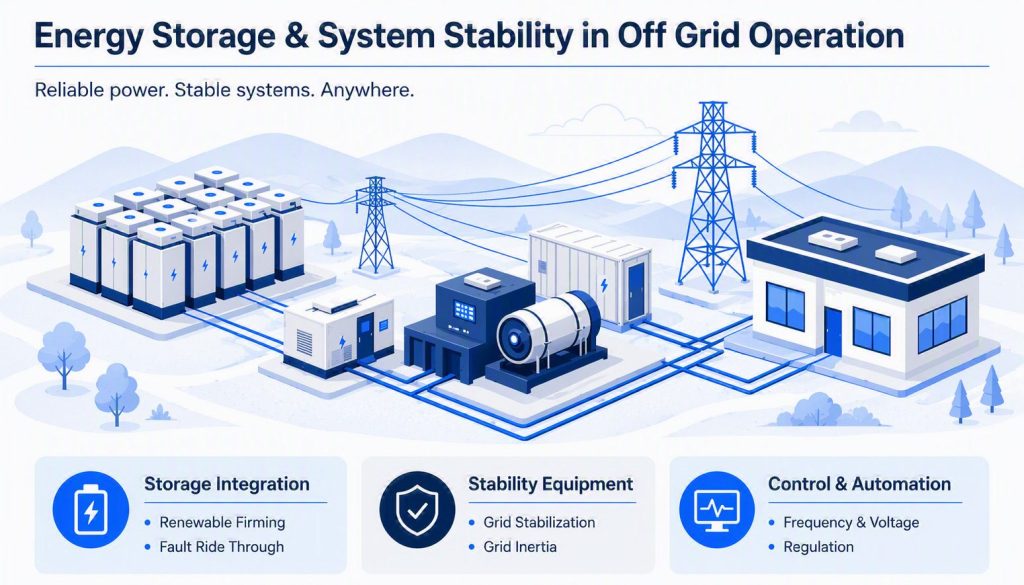
In grid-independent data centres, energy storage is not an auxiliary layer. It is a core part of the system. Battery energy storage systems provide far more than short duration backup. When integrated effectively, they can firm renewable generation, manage load step changes, support frequency and voltage regulation, and reduce reliance on thermal generation during normal operation.
While renewables and battery energy storage can make a significant contribution to off grid performance, they are unlikely on their own to support continuous hyperscale loads without substantial generation overbuild and long duration storage. In practice, most truly grid-independent data centres will still require firm, dispatchable supply such as gas turbines, reciprocating engines, HVO ready generation, fuel cells, hydrogen ready assets, or equivalent power generation solutions.
Storage layout decisions also have system wide implications. Distributing storage across multiple power conversion units can improve resilience and align naturally with medium voltage collector architectures. Storage capacity and rating must be defined not only by autonomy requirements, but also by the services the batteries are expected to provide during transient and fault conditions. This includes ride through capability, dynamic response, and coordination with other network assets.
Unlike grid connected facilities, islanded data centres must create and maintain their own electrical reference. This means system stability must be addressed explicitly through frequency control, reactive power management, and harmonic mitigation. The role of synchronous condensers, static compensators, or advanced inverter control strategies should be considered early, before the design becomes difficult to modify. Stability equipment should also be positioned to avoid single points of failure and integrated clearly with protection and control philosophies.
Black start capability, orderly shutdown, and controlled system restoration are further features that distinguish grid-independent data centres from conventional facilities. These operating scenarios should be tested conceptually during early design to confirm that the selected electrical architecture can support them.
The scale and complexity of grid-independent data centre energy systems make digital engineering essential. A structured common data design environment provides a single source of truth for multidisciplinary design information, helping teams coordinate in real time across civil, electrical, and digital workstreams. Federated digital models support early clash detection, more informed constructability reviews, and clearer interface definition between generation fields, storage zones, switching stations, and data centre infrastructure.
Digital delivery extends well beyond design coordination. When models are structured properly, they can also support construction automation, remote monitoring, and long-term digital operations. Geospatial coordination frameworks enable a high level of accuracy for the installation of trenches, foundations, and equipment, reducing rework and improving safety, particularly on large or remote sites. Integrated communications infrastructure also supports telemetry, diagnostics, and progressively more automated operations and maintenance.
Importantly, automation readiness does not require full deployment from day one. It depends on making sure that early design decisions do not constrain future operating models. Power and communications corridors, equipment spacing, and data structures should all support staged adoption as operational requirements evolve.
Grid-independent does not mean static or permanently isolated. Many data centres will evolve over time as demand grows, generation mixes change, or grid and export connections become viable. Strong designs anticipate that evolution by allowing modular expansion of generation and storage, adaptable medium voltage routing, and reconfiguration of switching arrangements without disruptive rework.
Space reservation, scalable collector systems, and future ready protection philosophies make it possible for facilities to move from isolated operation to hybrid or grid connected modes as circumstances change. Maintaining digital continuity from concept through construction and into operations also ensures that future upgrades are informed by accurate asset data rather than outdated legacy documentation.
Grid-independent data centres sit at the intersection of energy infrastructure, digital delivery, and long-term resilience planning. Their success depends not on any single component, but on how effectively generation, storage, networks, stability systems, and digital platforms are brought together into a coherent whole. Engineering these facilities requires clear availability objectives, disciplined system thinking, and design decisions that reflect the full asset lifecycle.
As demand for reliable and geographically flexible digital infrastructure continues to rise, grid-independent data centres will play a growing role in the next generation of energy and infrastructure engineering. Those designed as integrated energy systems from first principles will be best placed to deliver reliability today and adaptability tomorrow.
As the world accelerates towards net zero, subsea power cables are becoming vital links that connect offshore renewable energy to mainland grids across borders.
Submarine cables are critical infrastructure for global connectivity and renewable energy transmission. However, installing these systems involves overcoming diverse challenges, ranging from shallow water constraints to deep-sea rocky terrains.