
Expertise


Desde los primeros pioneros en el Esquema Hidroeléctrico Snowy Mountains hasta nuestros líderes e innovadores de hoy, nuestra gente nos hace quienes somos.
A través de nuestra red de especialistas globales y colaborando con socios locales, lo conectamos con los mejores equipos y capacidades para brindar soluciones altamente innovadoras y sostenibles.
Como organización, evaluamos continuamente las formas en que podemos brindar un lugar de trabajo seguro, flexible, inclusivo y respetuoso para nuestra gente y nuestros clientes.
Las personas están en el corazón de nuestra organización, nos esforzamos por crear un entorno flexible, diverso e inclusivo que permita a nuestra gente prosperar al máximo de su potencial.
Explore career opportunities
More than 600 cable systems carry 99 percent of intercontinental data and an increasing share of international electricity supply across 1.8 million kilometres of seabed. While fault rates per kilometre have fallen significantly over the past decade, recent incidents have highlighted a critical shift: system resilience is now defined less by how rarely cables fail and more by how quickly they can be restored when they do.
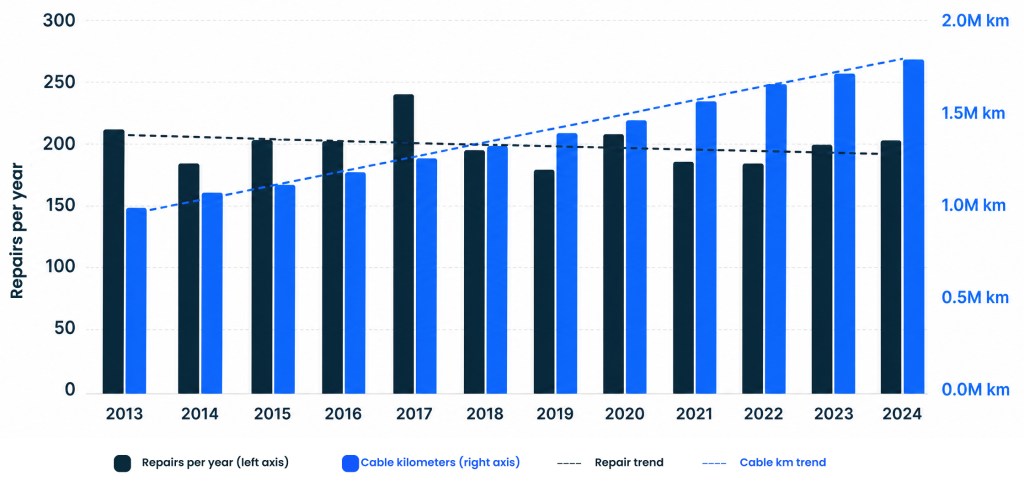
Despite a 77 percent increase in global cable length since 2013, annual repairs have remained broadly constant at around 200 per year. This reflects material progress in route engineering, burial practice and installation quality. However, restoration timelines remain long, particularly in Asia Pacific, where average repairs can take 30 days or more. With global cable kilometres projected to grow sharply by 2040 and large parts of the repair fleet approaching end of life, the restoration ecosystem faces increasing structural pressure.
Subsea cable delivery has traditionally treated repair as a downstream operational concern, separate from early design and planning decisions, but as cable systems become longer, more numerous and more geopolitically sensitive, this separation is no longer sustainable.
At the second Valentia Island Symposium on Subsea Cable Security and Resilience in Co Kerry, Ireland SJ’s Principal Project Manager, Mohanan Panayamadam presented a paper that makes the case for a shift from reactive repair to proactive restoration, where restoration readiness is embedded at the earliest project stages. Route selection, burial depth, protection philosophy, operating model and permitting strategy must be considered together as an integrated resilience system, rather than sequential disciplines.
This restoration-focused perspective builds directly on our planning frameworks for subsea power cable development, including:
Together, these perspectives link early engineering decisions with long term operability and recoverability.
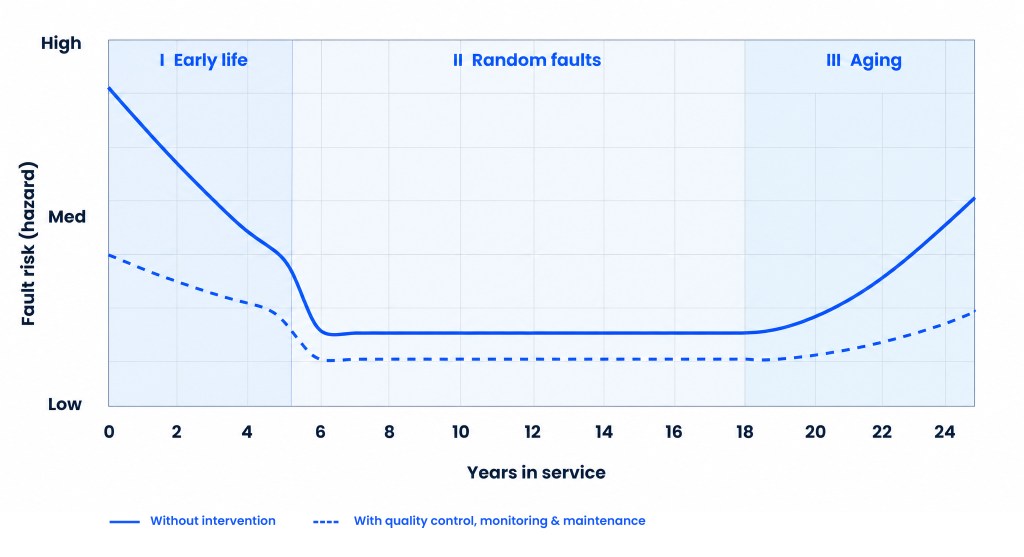
Subsea cable failures follow a well understood lifecycle pattern, with fault risk higher in the first years after installation due to installation quality issues, manufacturing defects and early design decisions. Fishing and anchoring activity near landing stations account for most early life failures, supplemented by poor splices and occasional component defects. Quality control investments deliver their highest return in this phase. Measures such as thorough geophysical and geotechnical surveys, cable burial risk assessments, zone matched armour selection, and rigorous factory and system acceptance testing can significantly compress the early failure period.
The long mid-life period establishes an irreducible baseline of approximately 150 to 200 repairs per year globally. Around 86 percent of these faults are caused by ship anchors and fishing trawls, with geological events such as turbidity currents accounting for a smaller number of high impact incidents. These failures cannot be eliminated entirely, but their likelihood and consequences can be reduced through monitoring, deterrence and faster response.
As cables approach or exceed their 25-year design life, fault frequency rises due to repeater failure, insulation breakdown and corrosion at joints. End of life resilience depends on planned maintenance, health monitoring and integration of upgrade or replacement decisions into broader capacity planning.
A cable managed actively across all three phases experiences substantially fewer failures and shorter outages over its lifetime, representing billions of dollars in avoided repair costs.
Prevention remains the most cost-effective resilience intervention. Modern route design integrates multiple survey and data layers simultaneously, including geophysical and geotechnical surveys, historical fault records, vessel traffic density and marine spatial constraints. AI assisted optimisation now enables faster, more consistent evaluation of route options and burial strategies, replacing months of manual probabilistic analysis with calibrated, segment specific outcomes.
During construction, techniques such as horizontal directional drilling at shore crossings and real time installation monitoring help eliminate the most vulnerable near shore sections. In operation, distributed fibre optic sensing, vessel behaviour analytics and formally defined cable protection zones improve early detection of threats and enable more effective deterrence of human caused damage.
These approaches directly complement the structured planning and route definition methodologies described in our Beyond Borders insights series, extending them from installation success into long term operational resilience.
When failures do occur, restoration timelines remain constrained by multiple interacting factors. The global repair fleet is limited in number, ageing and unevenly distributed. Nearly all faults occur within territorial waters or exclusive economic zones, requiring national permits before work can commence. Technical complexity, weather windows, specialist workforce shortages and long lead times for proprietary spares further extend outages.
These constraints compound rather than act in isolation. A vessel may be available but delayed by permitting, and permits may be issued but operations suspended due to weather, with multiple break points triggering repeated mobilisation and approval cycles. Without structural reform, delay remains the default outcome even for technically straightforward repairs.
There is no single optimal operation and maintenance model for subsea cable systems, with viable approaches ranging from full asset ownership to consortium-based arrangements, managed services and sovereign backed models. In practice, resilient systems adopt hybrid structures that balance portfolio scale, security sensitivity, response time requirements and capital appetite.
Aligning the operating model with the strategic importance and risk profile of the cable system is critical. Over investment can lock in underutilised assets, while under provision leaves infrastructure exposed to prolonged outages during major incidents.
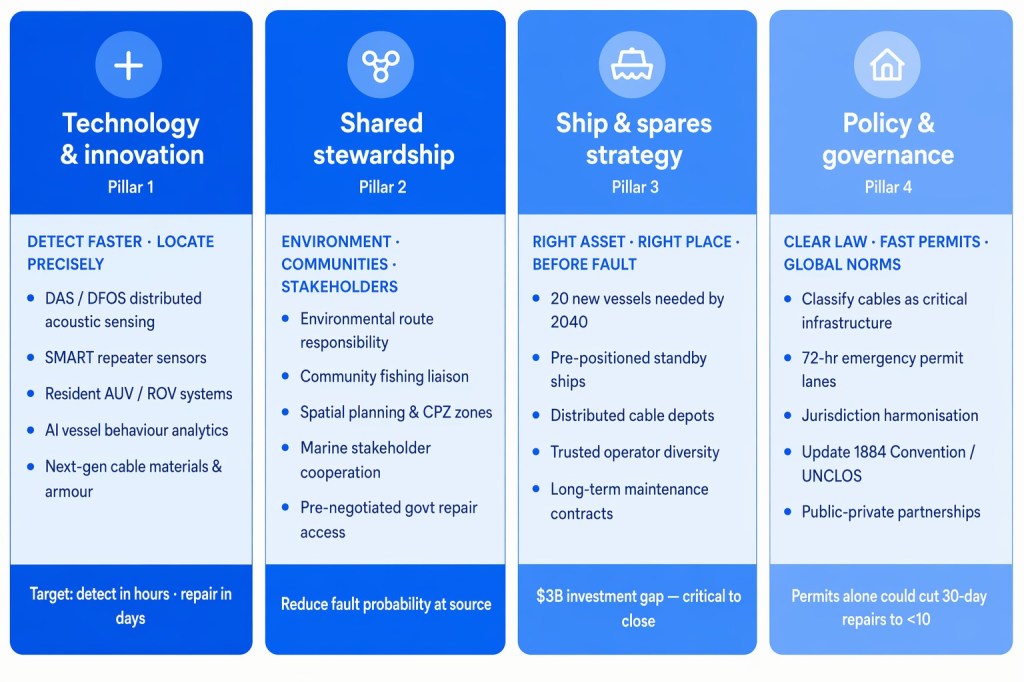
The paper presented at the Symposium sets out a four pillar framework to accelerate repair and improve resilience.
Intelligent sensing, predictive analytics and autonomous inspection systems compress detection and localisation timelines, enabling faster mobilisation and more targeted intervention.
Most faults are human caused. Engagement with fishing communities, marine stakeholders and regulators, supported by transparent spatial planning and protection zones, reduces preventable damage.
Pre-positioned repair vessels, regional spares depots and long term contracts are essential to overcoming fleet fragility and financing new capacity.
Permitting reform offers the greatest return on investment. Pre-negotiated emergency access agreements and streamlined processes could reduce repair times from weeks to days without a single new ship.
Taken together, these measures can reduce restoration timelines from weeks to days.
Resilient subsea cables are not defined by protection measures alone. They depend on integrated planning across design, monitoring, operation and governance. A well installed cable, continuously monitored and supported by accessible vessels, spares and permits, will fail less often and be restored far more quickly when it does.
Prevention and preparation are not additional costs; they are the investments that keep global data flowing and regional energy systems secure.
As the world accelerates towards net zero, subsea power cables are becoming vital links that connect offshore renewable energy to mainland grids across borders.
Submarine cables are critical infrastructure for global connectivity and renewable energy transmission. However, installing these systems involves overcoming diverse challenges, ranging from shallow water constraints to deep-sea rocky terrains.
Surbana Jurong (SJ) was engaged to provide critical technical support — from project management and stakeholder coordination to technical design and marine survey execution — for one of the country’s first subsea renewable energy transmission projects.