


Expertise


From the early pioneers on the Snowy Mountains Hydroelectric Scheme, to our leaders and innovators of today, our people make us who we are.
Through our network of global specialists and by collaborating with local partners, we connect you with the best teams and capabilities to deliver highly innovative and sustainable solutions.
As an organisation we are continually evaluating ways we can better provide a safe, flexible, inclusive and respectful workplace for our people and clients.
People are at the heart of our organisation, we strive to create a flexible, diverse and inclusive environment that enables our people to thrive to their fullest potential.
Explore career opportunities
The market for methane generation from sustainable sources is mature, yet the biomethane sector remains in a formative stage that presents both significant challenges and transformative opportunities, especially for pioneering players willing to lead infrastructure development and market creation.
Biomethane, a refined form of biogas produced from organic waste, agricultural residues, and wastewater, offers a renewable substitute for fossil natural gas. It can be seamlessly integrated into existing gas infrastructures, enabling power generation and industrial applications to reduce carbon footprints without costly retrofits. Biomethane provides an immediate pathway for emissions abatement and clean energy substitution. Given the right approach, biomethane can provide a supplemental fuel source and offer carbon reduction initiatives for energy generation companies.
Globally, according to The Biomethane Market Report by The Business Research Company, the biomethane market is expanding robustly, projected to grow from approximately $3.79 billion in 2024 to $5.05 billion by 2029, with a compound annual growth of around 5.7%. This growth is driven by increasing renewable energy commitments, tightening environmental regulations, rising corporate sustainability targets, and advances in waste-to-energy technologies.
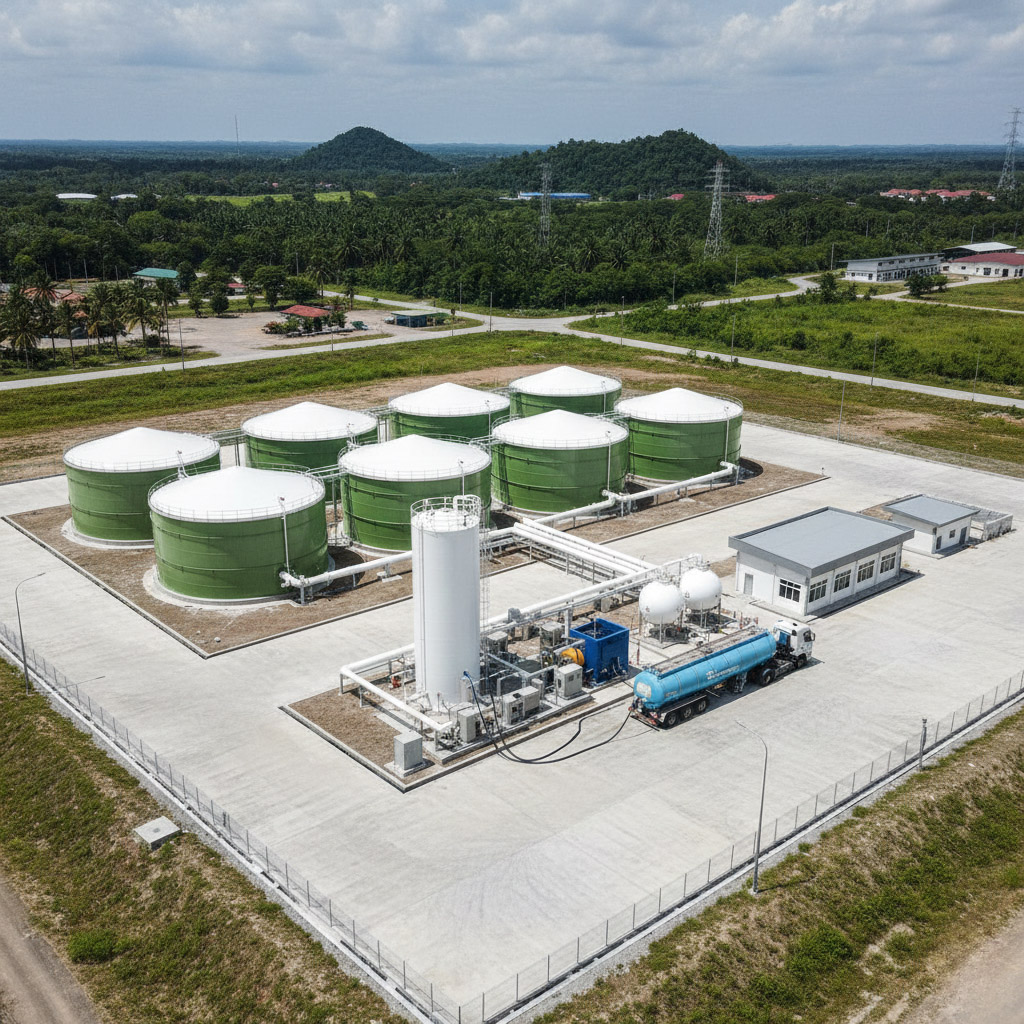
Aerial view of a typical biomethane generation facility utilising biomass waste feedstock
Several converging factors are accelerating the biomethane market evolution:
Despite a promising outlook for biomethane in Southeast Asia, several structural market barriers impede sector growth. Early pioneers in the industry face significant infrastructure burdens, as they must bear the upfront costs and navigate the complexities of developing foundational systems to aggregate feedstocks and connect markets efficiently. This challenge is exacerbated by the decentralisation of feedstocks, with biomass sources scattered across agricultural or remote areas, making cost-effective collection and supply chain development particularly difficult.
Feedstock scarcity remains a concern. Currently, most biomethane in Southeast Asia is derived from agricultural waste, especially palm oil mill effluent, due to its consistency and widespread availability, often at negligible cost. However, as market demand for biomethane increases and more developers participate, the ecosystem must expand to incorporate a broader range of organic waste streams, such as farming remains, food and industrial residues, forestry by-products, and municipal landscape waste. This diversity is crucial to sustaining industry growth and avoiding supply limitations.
Offtake pricing pressures present another barrier. At present, biomethane’s market price often falls below production costs, undermining the financial viability of new projects and discouraging investment despite the apparent environmental and energy security benefits. In addition, operational risks, such as exposure to climate change impacts or variability in mill performance can threaten feedstock availability and continuity of production.
Market fragmentation is also an issue, as aggregators and developers typically operate in isolation or silos, which restricts collective scale and efficiency gains in supply chain integration. Furthermore, the absence of well-established technical standards for biomethane quality and production perpetuates the sector’s status as a nonessential fuel source. Without credible standards, it becomes difficult to classify biomethane as a truly sustainable and reliable energy option, complicating matters for both developers and end users.
Collectively, these barriers highlight the need for coordinated regulatory frameworks, market incentives, and supply chain innovation to unlock biomethane’s full potential as a sustainable energy solution for the region.
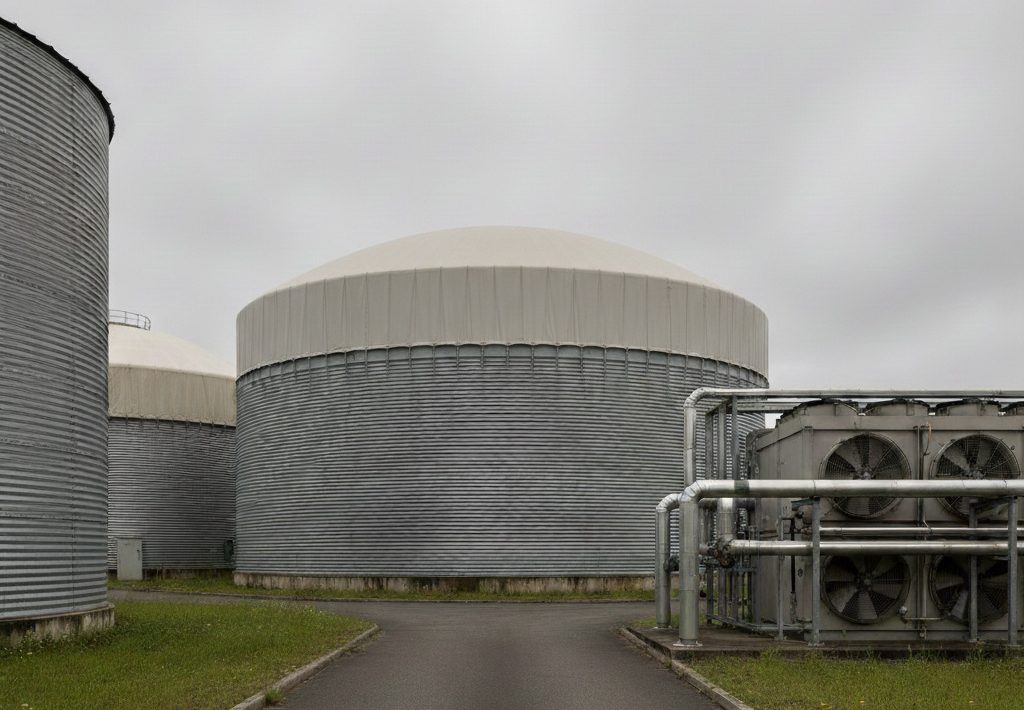
Typical arrangement and build of a biogas tank digester
Establishing integrated aggregation systems is a key solution for advancing the biomethane sector in Southeast Asia. By developing strategic collection hubs that are closely tied to localised demand nodes, it is possible to optimise feedstock volumes and logistics, ensuring that resources are efficiently mobilised and the supply chain is strengthened.
The formation of collaborative sector partnerships is critical. To achieve comprehensive market growth, all stakeholders, including compressed natural gas (CNG) sectors, regulators, and private developers need to operate within unified frameworks that balance diverse interests and encourage coordinated action throughout the value chain.
Techno-commercial risk management also plays a vital role. Engineering solutions should be grounded in realistic operational assumptions and must incorporate adaptive features designed to address uncertainties in feedstock supply, price fluctuations, and potential operational disruptions. This approach helps minimise investor risk and bolsters sector resilience.
Governmental incentives are necessary to mobilise capital and de-risk early-stage projects. Policy tools such as tax incentives, financing schemes, and local government support can drive investment and accelerate adoption of biomethane technologies. Such measures have proved effective in regional models like Thailand, Indonesia, and Singapore, catalysing industry expansion and enabling pioneering projects to flourish.
A large and diverse pool of resources underpins the sector’s potential. Biomethane can be derived from any organic material, including non-homogenous feedstock provided that suitable technology and operational setups are in place. By strategically locating biomethane plants close to multiple feedstock sources and within practical distances from aggregation points or offtake markets, production can be scaled effectively and sustainably.
The biomethane industry’s relevance in SEA is long-term, anchored by the need for sustainable commodities and clean energy. Entering the biomethane space now offers early movers’ prominence in emerging national markets, positioning them as essential players in the clean energy transition. A strategic focus on biomethane can unlock economic, environmental, and energy security benefits, contributing meaningfully to net-zero pathways.
By fostering multi-stakeholder collaboration, advancing policy clarity, and investing in robust infrastructure, the biomethane market is poised to surge ahead. Market participants prepared to pioneer in this space will not only capture immediate growth but will shape the future landscape of sustainable energy.