

Expertise


From the early pioneers on the Snowy Mountains Hydroelectric Scheme, to our leaders and innovators of today, our people make us who we are.
Through our network of global specialists and by collaborating with local partners, we connect you with the best teams and capabilities to deliver highly innovative and sustainable solutions.
As an organisation we are continually evaluating ways we can better provide a safe, flexible, inclusive and respectful workplace for our people and clients.
People are at the heart of our organisation, we strive to create a flexible, diverse and inclusive environment that enables our people to thrive to their fullest potential.
Explore career opportunities
Foundational concepts of DE are built through a solid knowledge of Design Authoring, Model Federation, and Levels of Development (LOD).
Design Authoring involves creating discipline-based designs using various software platforms.
Model Federation incorporates models, usually from multiple disciplines and authoring tools, into a single entity that visually represents clients’ expected deliverables. In simple terms, a federated model is a super model. Model federation refers to the process of developing the federated or aggregated model.
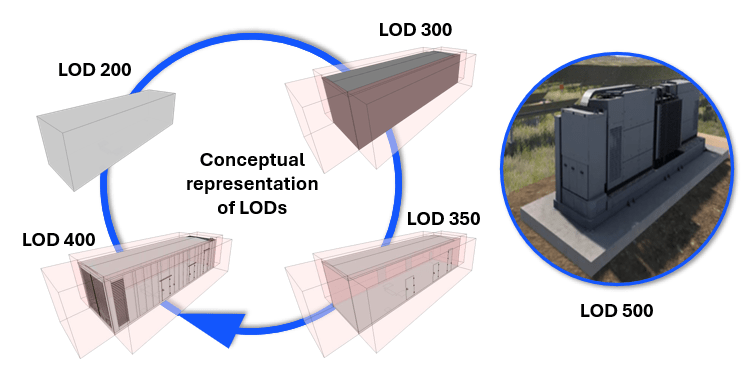
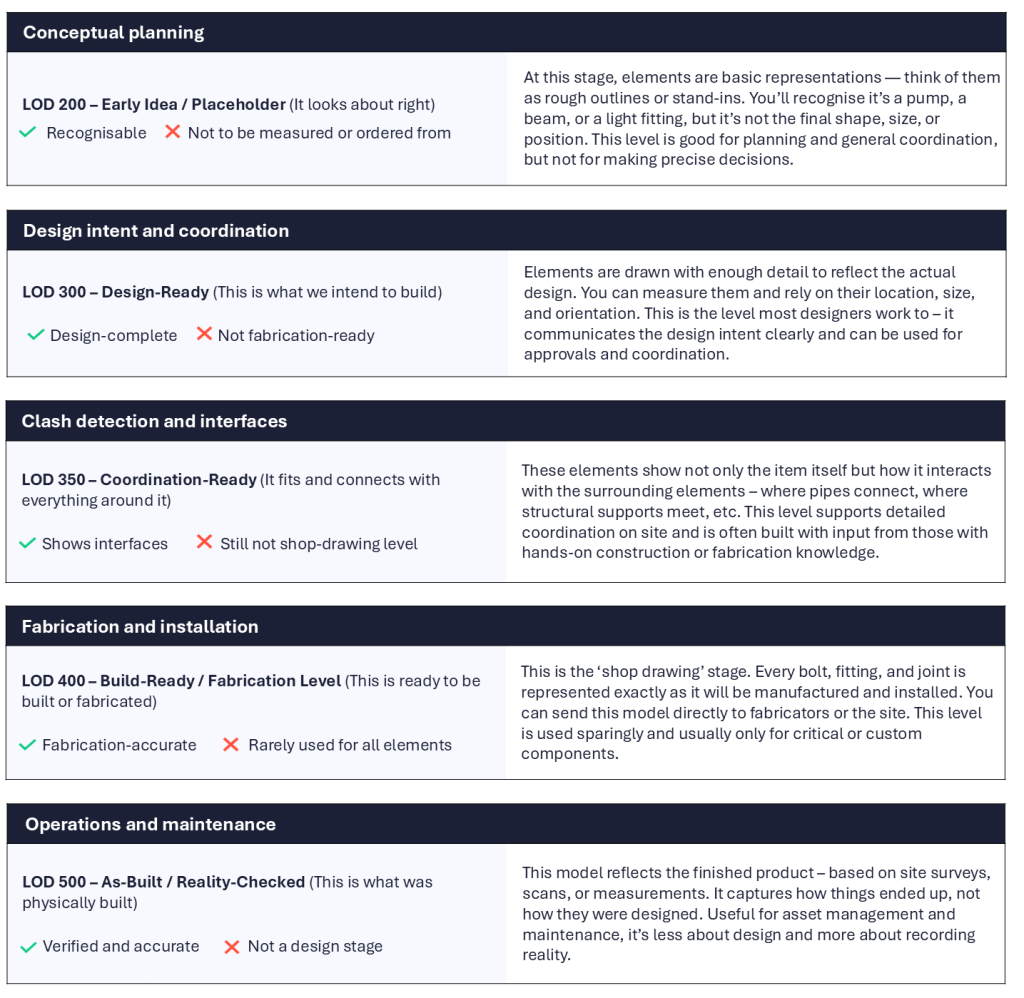
Levels of Development (LOD): Defines the extent to which model elements are graphically represented. The Level of development of an object / element within a model refers to the extent to which it has been graphically modelled. Generally, six levels of developments are considered acceptable: LOD 100, LOD 200, LOD 300, LOD 350, LOD 400 and LOD 500. Understanding Levels of Development (LOD) is important in fostering collaboration between stakeholders. The following matrix simplifies the definitions of LOD 200 – LOD 500.
Digital Engineering works best when all disciplines within the delivery and asset lifecycle are actively engaged in focused and intentional collaboration and coordination. While all disciplines within the delivery and asset lifecycle are important, two key enabling disciplines for Digital Engineering are Building Information Modelling (BIM) and Geographic Information Systems (GIS).
Provides a digital representation of physical and functional attributes of assets, crucial for precise planning and management. BIM is often interchanged with Digital Engineering but is more accurately a sub-component of it.
Geographic Information System (GIS) provides the ability to capture, store, analyse and visualise geospatial data. GIS utilises computer-based applications to enable user creation of interactive queries, as well as storage and editing of spatial and non-spatial data.
The LOI required for a group / class of objects is associated with the non-graphical attributes of the objects in question. Usually, LOIs are captured within clients’ exchange information requirements (EIR) documents.
LOIN defines the Level of Information required to be exchanged in line with Exchange Information Requirements. It specifies the quality, quantity and granularity of information to ensure compliance to defined requirements. The LOI required for a group / class of objects is associated with the non-graphical attributes of the objects in question. Usually, LOIs are captured within clients’ exchange information requirements documents.
Digital engineering promotes collaboration by reducing “information islands” during design, construction, delivery, and management of assets.
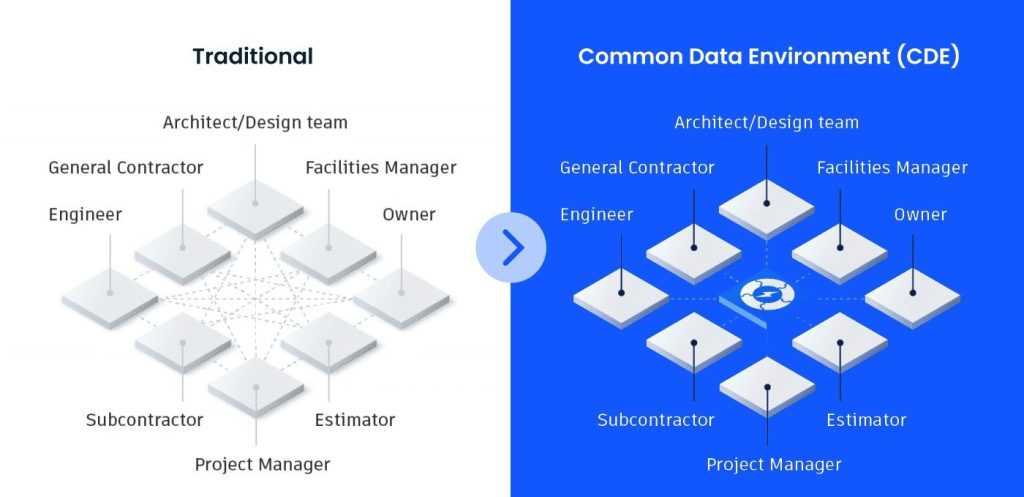
Source: United-Bim
The Common Data Environment (CDE) often referred to as the Single Point of Truth (SPoT) or a single source of Truth. The CDE is a repository that hosts: Federated models, Authoring models, Non-model data (2D drawings, textual documents, pictures, videos and audio files). The common data environment (CDE), is the single source of information used to collect, manage and disseminate documentation, the graphical model and non-graphical data for the whole project team.
Broadly, there are three key ways to classify the range of Digital Engineering tools and platforms, including:
Authoring tools can generate and edit designs per the requirements set out by the client (or appointing party). Visualisers enable the viewing of rich 3D and 2D information created by the authoring tools. Increasingly, authoring tools have 3D viewers integrated within the design environment.
Often, visualisation tools display the aggregated / federated model and allow users to check the integrity of the design, especially through collision / clash detection, assessment, analysis and reporting.
CDEs serve as Digital Engineering information and data ecosystems and aid team coordination as well as information, model, and design coordination.
How do the principles of people, process, and technology come together to deliver consistent, reliable, and innovative digital engineering solutions?
It begins with People. Enabling capability starts with identifying mentors, articulating expectations, undertaking training, and investing in continuous professional development. Setting challenges to solve real-world problems further enhances skills and knowledge.
Next is Process. Process flows can be leveraged by reviewing current processes, educating teams on optimal approaches, and driving continuous improvements. Measuring outcomes is critical to understanding the impact of these improvements. Attributes that indicate process leverage include reduced project delivery time, predictable, repeatable, and reliable value to clients, and increased savings generated during and after delivery.
Finally, there’s Technology. The impact of technology adoption can be measured by driving and measuring efficiency gains from leveraging relevant technology and instigating systematic cultural change. Establishing tailored Electronic Document Management Systems (EDMS) and Common Data Environments (CDEs) is essential. Exploring emerging technologies and assessing their ability to provide client-tailored solutions is also crucial for staying ahead.
To ensure consistency in how projects adopt and deploy the right technology, several steps must be taken.
Digital Engineering standards ensure that delivery systems (including technology platforms, delivery templates, and optimised workflows) are designed and implemented in a consistent and reliable manner. Compliance to standards improves the quality of our services, reduces the risk of errors or rework, and aids our evolving leadership in the DE space. In each project it is key to define the applicable standards by assessing the project delivery and client requirements as well as to map the defined standards to specific delivery outcomes / processes. Where possible, create rules that check deliverables for compliance to defined standards.
Consistency and reliability: By adhering to industry DE standards, services are delivered in a consistent and reliable manner. This improves client satisfaction and contributes to a stronger market reputation.
Lifecycle Impact: Standards aid service outputs during project delivery by reliably forecasting how clients’ Operations and Maintenance activities can be streamlined with cost reduction implications which can increase profitability.
Unlocking new value: In a rapidly changing market, Digital Engineering is empowering stakeholders to generate new value which can: unlock new opportunities, drive growth, and deliver efficiencies. DE Standards play a key role in achieving these goals by providing a framework for innovation and continuous improvement.
As SJ continues to evolve into a data-driven organisation, the focus on digital engineering will play a pivotal role to
In conclusion, the integration of digital engineering into operations, along with a commitment to People, Process, Technology, and Standards ensures consistent, reliable, and innovative digital engineering solutions that drive growth and enhance client satisfaction.
Digital transformation is well established throughout Engineering Consultancies, with digital teams and digital tools peppered throughout service offerings. While these services and tools provide strong value, the greater advantage comes when an organisation embraces a digital mindset; harnessing technology, data, and continuous learning to deliver truly exceptional outcomes for our clients and communities.
From major transport networks to renewable energy developments and water security projects, engineering is becoming increasingly data-driven, unlocking new possibilities for efficiency, cost savings, and long-term resilience