


2026 National Transport Conference


From the early pioneers on the Snowy Mountains Hydroelectric Scheme, to our leaders and innovators of today, our people make us who we are.
Through our network of global specialists and by collaborating with local partners, we connect you with the best teams and capabilities to deliver highly innovative and sustainable solutions.
As an organisation we are continually evaluating ways we can better provide a safe, flexible, inclusive and respectful workplace for our people and clients.
People are at the heart of our organisation, we strive to create a flexible, diverse and inclusive environment that enables our people to thrive to their fullest potential.
Explore career opportunities
Transport planning has always required decision-makers to balance competing priorities. Travel behaviour is evolving, technology is reshaping how people and goods move, and communities expect transport investments to deliver broader social, economic and environmental outcomes. Governments and infrastructure owners face growing pressure to make decisions that provide long-term value in an increasingly constrained and uncertain environment. What is changing today is the scale and complexity of those decisions. For transport planners, understanding these interacting forces has become just as important as forecasting future demand.
These challenges sit at the heart of the 2026 National Transport Conference theme, Shaping the future, moving the now. This focus recognises the need for transport planners to address immediate network pressures while making decisions that enable long-term transformation. At the conference, SMEC’s transport planning and advisory experts will share practical insights drawn from projects across Australia and internationally.
Transport agencies are responding to a convergence of pressures including urban growth, technological disruption and evolving community expectations. As explored in SMEC’s recent thought leadership article on sustainable transport, the challenge is no longer simply expanding capacity. It is creating transport systems that are resilient, inclusive and adaptable while continuing to support economic productivity and community wellbeing. This demands a more integrated approach to planning, where environmental, social and operational outcomes are considered together from the earliest stages of decision making.
Transport planners are increasingly being asked to make confident decisions in changing and uncertain environments. This requires an understanding of how travel behaviour is changing, how networks function as connected systems, and how communities and stakeholders experience transport in practice. By bringing these perspectives together, planners can better navigate uncertainty, evaluate trade-offs and develop transport strategies that respond to today’s challenges while remaining adaptable to future change.
Transport networks have always evolved in response to changes in population, land use, technology and economic activity. The COVID-19 pandemic provided one of the clearest examples of this shift. Accelerated by the rise of hybrid work, travel patterns changed rapidly and disrupted many of the assumptions traditionally used to forecast demand and prioritise investment. At the same time, governments and infrastructure owners faced growing pressure to make fiscally responsible decisions to improve network resilience, maintain performance and deliver long-term value. In this environment, understanding how movement patterns are evolving has become just as important as forecasting future demand.
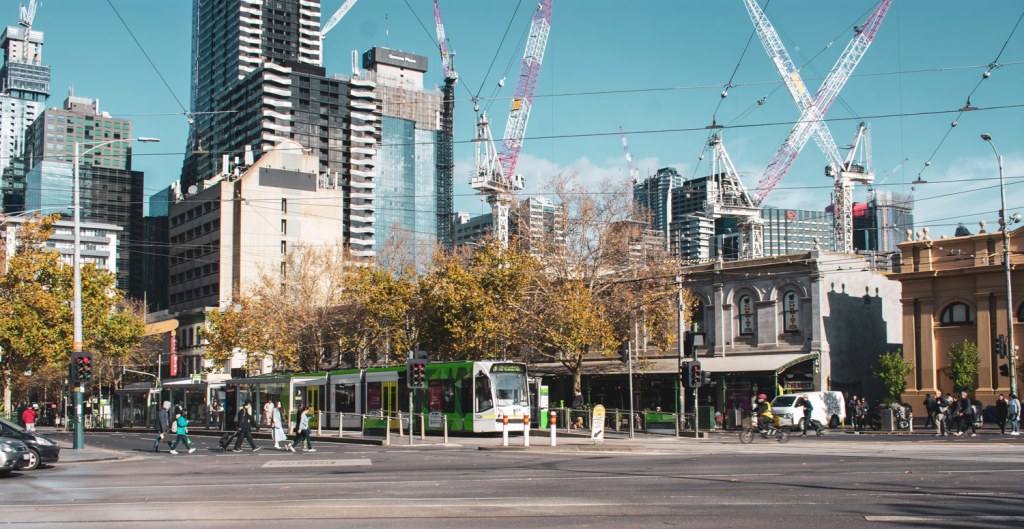
In Australia, Melbourne’s CBD experienced some of the world’s longest and most restrictive lockdowns. This experience offers a valuable insight into what has endured, what has changed and how transport networks are adapting to a new baseline for movement. With several years of post-pandemic data now available, one of the clearest findings from the analysis is that Melbourne’s CBD has evolved rather than reset. While weekend activity has almost recovered to 2019 levels, weekday activity has stabilised at lower levels. Mondays and Fridays remain noticeably quieter than mid-week, and the traditional morning commuter peak is less pronounced. Together, these trends suggest that hybrid work has become a structural force reshaping travel demand, public transport use and the performance of city precincts. For transport planners, the implication is clear: future networks must respond to a new baseline characterised by flatter peaks, stronger off-peak activity, greater variation between precincts and increased flexibility in when, why and how people travel.
The research also highlights the growing value of integrated data in transport planning. Pedestrian sensors, public transport patronage, traffic volumes and geospatial datasets each tell part of the story. Combined, they provide a more complete picture of how cities are functioning and how movement patterns are changing, helping planners respond to increasingly varied travel behaviour and challenge long-held assumptions about demand. The same principle underpins major infrastructure projects such as Sydney Gateway, where large-scale mesoscopic and microscopic traffic modelling helped evaluate network performance and inform decision-making from business case development through to construction. Understanding what has changed, what has endured and what is still evolving enables planners to make more confident decisions and better prepare transport networks for the future.
As transport networks become more complex, the impacts of individual projects are increasingly felt beyond the asset itself. A road upgrade, rail corridor, active transport connection or precinct intervention influences not only movement, but also accessibility, safety, economic productivity, land use and community outcomes. Understanding these interactions is becoming increasingly important as planning decisions influence a wider range of outcomes than ever before.
Effective network planning requires multiple perspectives to be considered together. The greatest value is realised when investments improve how people, goods and services move across the broader network, rather than simply optimising the performance of a single asset. Taking a movement and place approach helps planners balance network efficiency with the social and economic value of the places people move through every day.
While projects are often developed and delivered individually, communities experience transport as a connected system. Strategic modelling, demand forecasting, freight planning, public and active transport planning, road safety, economics and stakeholder perspectives all help inform how investments contribute to long-term transport outcomes. Bringing these disciplines together allows planners to better understand trade-offs, identify opportunities and develop solutions that deliver value across multiple objectives rather than a single outcome.
Decisions made during the early planning stages are often the most influential, shaping how infrastructure performs within the broader network over its entire life. By testing options early and understanding the relationship between land use, movement and network performance, planners can identify integrated solutions that address multiple challenges at once. This approach has been applied across projects such as the Inland Rail Program, Cross River Rail Precinct Engineering, Launceston Gateway Precinct Freight Demand Analysis, and the Mumbai-Ahmedabad High Speed Rail Project, where integrated planning helped inform investment decisions, improve connectivity and support long-term network outcomes. Similar thinking underpinned SMEC’s work on the SEQ People Movement Study, which informed the TransformingSEQ vision of a more connected region through improved public transport integration, active transport connectivity and future mobility solutions.
Infrastructure must respond to the places, cultures and communities it serves. This is particularly important in international markets, where successful outcomes depend not only on technical solutions, but also on understanding local governance structures, stakeholder expectations and the broader context in which decisions are made. Navigating these local realities starts with understanding the people involved.
Effective stakeholder engagement depends on recognising how information is received, interpreted and acted upon by different audiences. While digital tools and online research provide valuable context, they rarely capture the subtleties of how transport systems operate in practice in one region versus another, or how individual communities experience them. Observing places firsthand often reveals insights into travel behaviour, accessibility barriers, community priorities and stakeholder dynamics that may not be visible in a dataset.
These insights also shape how projects are delivered. Approval processes, communication styles and stakeholder relationships vary significantly between regions and organisations. In some environments, decision-making follows highly structured pathways with formal approvals and defined reporting requirements. In others, engagement may be more flexible and relationship-driven. Understanding these differences allows project teams to communicate more effectively, build trust and navigate delivery challenges with greater confidence.
By combining analytical tools with an understanding of local contexts, planners gain a more complete picture of the challenges they are seeking to address. This approach informed the Dhaka Outer Ring Road project in Bangladesh, where transport planning, traffic modelling, population growth forecasting and local stakeholder considerations helped identify solutions balancing mobility, economic and community outcomes. It also underpins the road safety capacity-building work project in the Solomon Islands, where collaboration with government and community stakeholders is helping strengthen institutional capability, improve coordination and translate policy into practical action. Together, these projects demonstrate how technical analysis and local insight can support more responsive, implementable transport solutions.
Transport planning sits at the intersection of evidence, policy, engineering, place and human behaviour. As the relationships between transport, land use, accessibility, economic productivity and community outcomes become more complex, effective planning depends on understanding how change in one part of the network can affect the whole.
Accessibility is linked to land use. Freight efficiency is linked to economic productivity and community impacts. Public transport is linked to walking, cycling and the quality of the first and last kilometre. This requires planners to identify how travel behaviour is changing, consider the broader network outcomes of individual investments and understand how communities and stakeholders experience transport in practice.
Whether planning future freight corridors, improving public transport networks, integrating active transport, or supporting rapidly growing cities, the challenge remains the same: making informed decisions through increasingly complex transport systems. Ultimately, this is how transport planning moves from prediction to preparedness. Effective transport planning provides the evidence, insight and strategic direction needed to understand change, evaluate trade-offs and create long-term value.
As the industry comes together to explore how we shape the future while moving the now, one principle is clear: resilient transport networks begin with better decisions today. Those decisions must be informed by evidence, grounded in place and focused on the people and communities who depend on them.
At SMEC, we see our role as helping clients simplify complexity. By combining technical expertise, network thinking and local insight, we help shape transport strategies that respond to today’s challenges while remaining adaptable to future change.