

Expertise


From the early pioneers on the Snowy Mountains Hydroelectric Scheme, to our leaders and innovators of today, our people make us who we are.
Through our network of global specialists and by collaborating with local partners, we connect you with the best teams and capabilities to deliver highly innovative and sustainable solutions.
As an organisation we are continually evaluating ways we can better provide a safe, flexible, inclusive and respectful workplace for our people and clients.
People are at the heart of our organisation, we strive to create a flexible, diverse and inclusive environment that enables our people to thrive to their fullest potential.
Explore career opportunities
Soft soils can shift as excavation progresses. Hard rock can fracture unpredictably, increasing the forces on equipment and support systems. Even temporary linings can respond differently once loads redistribute. These behaviours are common across tunnelling and they reinforce a fundamental truth, materials follow the laws of physics not our assumptions.
The Beneath the Surface series explores how engineers respond to this uncertainty. Earlier articles examined the role of risks in tunnel delivery and the rise of digital tools that help teams anticipate and adapt to changing ground conditions. This third instalment turns the focus to materials behaviour and how soils, rock and engineered supports perform in real tunnelling environments, and what recent insights from our specialists and collaborators mean for safer, more predictable delivery.
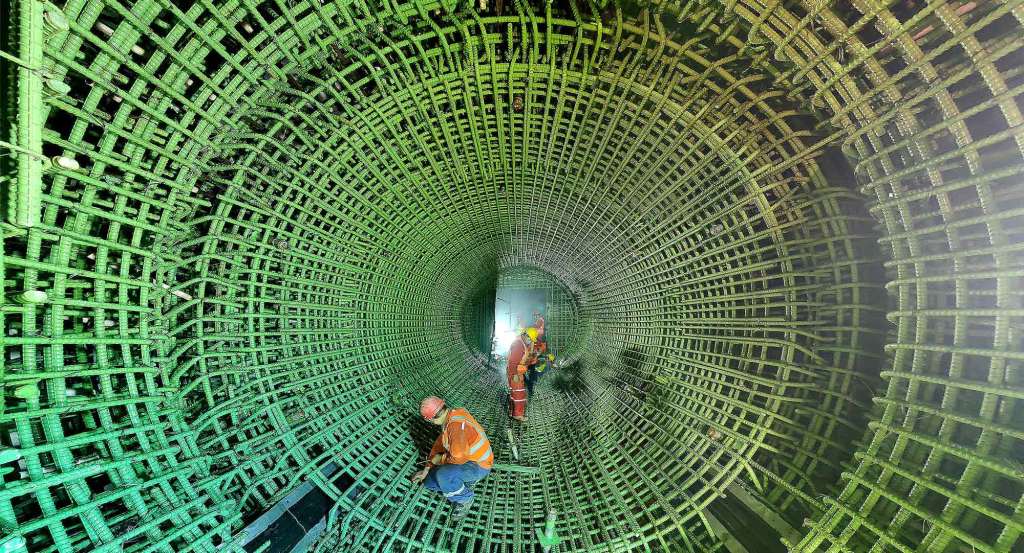 Rebar assembly underway for Cross Passage 3 within the Karnaphuli River Tunnel.
Artificial Ground Freezing (AGF) is a dependable way for stabilising soft or water-bearing soils for tunnelling works. The process involves circulating chilled brine or liquid nitrogen through a series of steel pipes, lowering the temperature of the surrounding ground. As pore water freezes, the soil mass transforms into a strong and water-tight mass that can temporarily act like a structural material
This technique is particularly effective for constructing cross passages between parallel TBM tunnels. These short connections frequently pass through loose or saturated ground that cannot maintain stability on their own. By freezing the soil first, engineers create a continuous stable ground that allow excavation to proceed safely in dry conditions
In recent SMEC work, as part of the design process, our engineers checked for the frozen zone using integrated thermal and structural modelling. This began with the modelling of the required thickness and temperature of the frozen wall. The performance of ground freezing is reviewed with the thermocouples installed in the ground to monitor the temperature of frozen ground, in real time. Excavation commenced only after verification that the frozen soil reached the required strength and temperature.
One of the main advantages of AGF is its predictability. Unlike methods that rely on grout injections or groundwater pumping, AGF allows engineers to directly measure ground performance before excavation starts. The frozen strength and stiffness can be quantified with high confidence, reducing uncertainty in complex or urban environments. In addition, AGF effectively blocks groundwater inflow, one of the most common sources of instability in soft-ground tunnelling (Tsang et al., 2019).
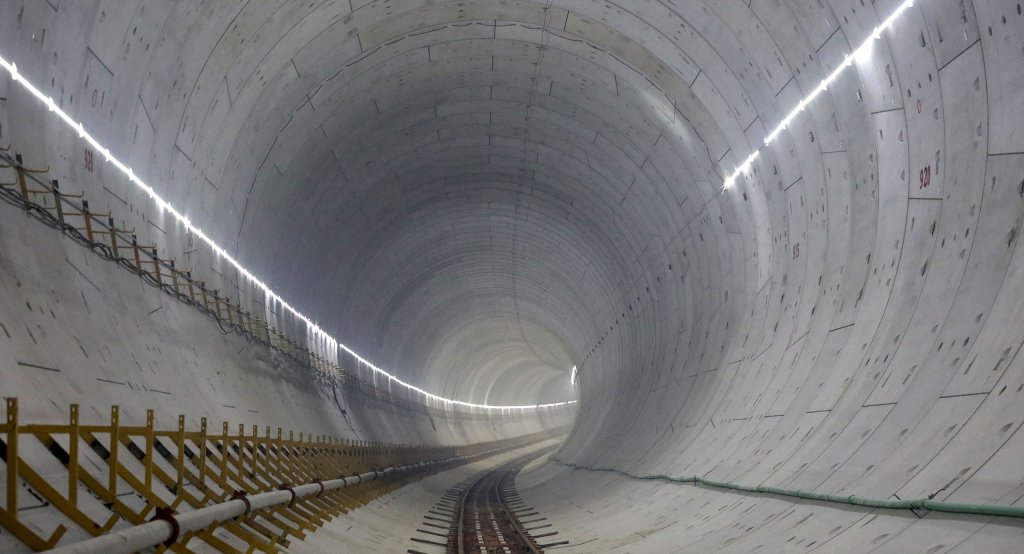 Inside of Karnaphuli Tunnel
In hard rock tunnelling, the engineering challenge shifts from stabilising soft soil to understanding how the rock mass fractures under excavation. The Tunnel Boring Machine (TBM) tunnelling process relies heavily on the rock breakage efficiency induced by the cutter head. TBMs use disc cutters that press into the tunnel face, creating fractures that propagate and eventually cause chips to break away. The spacing between these cutters is critical; when spacing is optimised, fractures link efficiently, and the rock detaches cleanly. If the spacing is incorrect the TBM encounters higher trust forces, uneven cutter wear, and reduced penetration performance.
To gain deeper insights into this behaviour, SMEC experts and research partners conducted detailed modelling of fracture development under various cutter spacing scenarios. The work focused on hard rock types known for directional strength and fracture, conditions that can make excavation outcomes more variable and harder to predict.
The modelling demonstrated that as cutter spacing increases toward approximately 100 millimetres, the rock begins to break more effectively and the TBM produces larger, cleaner chips. This results in more efficient cutting and lower mechanical loads on the TBM. When spacing exceeds this range, the fractures no longer connect across the face, meaning the rock does not break cleanly. Therefore, the TBM must apply greater force to advance, increasing both energy demand and cutter wear.
This highlights that even small changes in geological orientation can alter how the rock responds under load. By understanding geological condition including defects patterns in advance, engineers can optimise the cutter layout to suit the ground conditions, enhancing performance, reducing unnecessary loading and maintaining a more consistent excavation process (Salehi et al., 2024).
What connects these two examples is not just the engineering methods themselves, but the understanding of how materials behave under real tunnelling conditions. In soft ground, AGF transforms unstable soil into a temporary yet highly reliable support system. In hard rock, optimising cutter spacing helps keep excavation forces consistent and improves overall TBM performance. In both cases, better insight into material behaviours directly reduces uncertainty, which is one of the largest drivers of risk in underground works.
More broadly, this reflects a shift in how modern tunnels are designed and delivered. Safety is no longer achieved solely through additional support or conservative assumptions. Increasingly, it depends on understanding how ground and structural materials respond to stress over time, whether that response comes from frozen soil, fractured rock or the temporary linings that stabilise the excavation.
As projects extend into deeper, denser and more technically complex environments, this behaviour-led approach will grow in importance. When engineers can anticipate how the ground will react before excavation begins, decisions become clearer, designs become more efficient and construction outcomes become more predictable.
In tunnelling, that level of clarity means the difference between a smooth delivery and a difficult one, and in some cases the difference between a safe outcome and a risky one.
This is why behaviour-led insight sits at the core of SMEC’s approach to geotechnics and tunnels. Our understanding of ground and material behaviour continues to guide major infrastructure projects such as Sydney Metro West and Sydney Metro – Western Sydney Airport, where complex geological conditions demand this level of clarity. It reflects the depth of capability our teams bring to complex underground environments and the role this capability plays in enabling confident decisions from investigation through to delivery.
Tsang, C. K., Sia, T., & Li, F. (2025). Artificial ground freezing for cross passage construction. [Conference paper]. In Proceedings of the Australasian Tunnelling Conference 2025. SMEC.
Salehi, B., Rostami, J., Golshani, A., & Schneider-Muntau, B. (2025, November). Optimization of TBM cutter spacing in anisotropic hard rock using finite element analysis [Conference paper]. In Proceedings of the Australasian Tunnelling Conference 2025

