

Expertise


From the early pioneers on the Snowy Mountains Hydroelectric Scheme, to our leaders and innovators of today, our people make us who we are.
Through our network of global specialists and by collaborating with local partners, we connect you with the best teams and capabilities to deliver highly innovative and sustainable solutions.
As an organisation we are continually evaluating ways we can better provide a safe, flexible, inclusive and respectful workplace for our people and clients.
People are at the heart of our organisation, we strive to create a flexible, diverse and inclusive environment that enables our people to thrive to their fullest potential.
Explore career opportunities
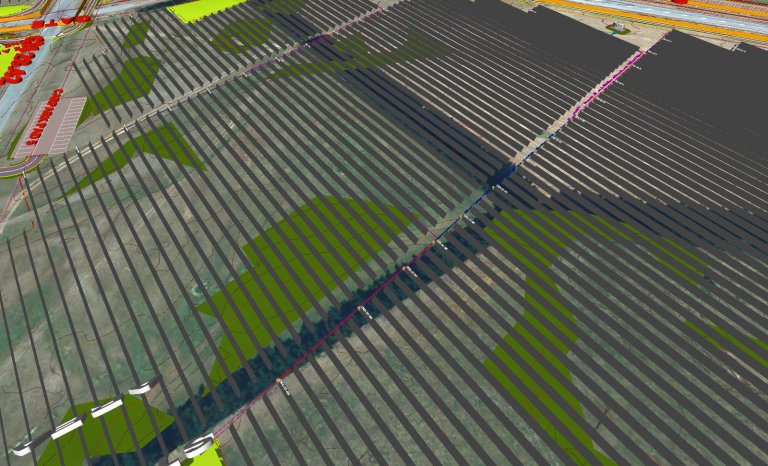
When this approach is supported by connected data and disciplined digital workflows, 3D conceptualisation becomes not just a visual tool, but a practical enabler of delivery certainty. Digital engineering connects the model to a common data environment, giving teams and clients a single source of truth for key project information, from federated models through to the supporting evidence base such as drawings, specifications, photographs and other project records. This improves traceability, reduces ambiguity, and helps ensure decisions are made using the latest approved information.
This matters on solar projects because delivery depends on multiple disciplines moving in lockstep. Bringing civil, survey, electrical and other design inputs into a single federated view strengthens coordination, makes interface issues easier to spot, and supports faster, more confident design iterations. The shift from 2D outputs to a coordinated 3D approach also improves how projects are visualised and reviewed, helping both project teams and clients engage with the design intent earlier and reduce errors that can drive rework later.
It also strengthens governance during planning and approvals. Clear document control, consistent naming conventions, and transparent review and approval workflows make it easier to track markups and issues, reduce time spent on file administration, and keep stakeholders aligned on what has changed and why. For project managers and discipline leads, that translates into cleaner coordination, fewer version conflicts, and more time focused on the decisions that protect programme, cost and quality.
When integrated with wider digital engineering tools, 3D conceptualisation also enables deeper analysis and stronger assurance. Design managers, engineering leads and construction readiness teams can link models to performance forecasting, structural checks and clash detection workflows, which helps refine layouts and equipment interfaces before the project reaches site.
The same approach supports scenario planning by enabling project delivery teams to visualise and assess options under different conditions, such as changes to drainage, access, landform or environmental constraints, so design choices can balance energy capture with environmental and social outcomes.
Virtual simulations also contribute to safer delivery and better readiness by familiarising construction teams with the site environment, sequences and procedures ahead of mobilisation, reducing uncertainty and improving on-site performance from day one.
Overall, 3D conceptualisation helps embed digital practices into everyday delivery, strengthening quality, safety and certainty across the solar farm lifecycle while delivering practical value for clients, communities and the environment.
In the rapidly evolving landscape of Infrastructure and Energy, SJ Group (SJ) is leveraging Digital Engineering as the vehicle for innovation and sustained digital transformation. The following article explores how to harness the power of digital engineering, moving beyond traditional methods to deliver consistent, reliable, and innovative solutions.