

Expertise


From the early pioneers on the Snowy Mountains Hydroelectric Scheme, to our leaders and innovators of today, our people make us who we are.
Through our network of global specialists and by collaborating with local partners, we connect you with the best teams and capabilities to deliver highly innovative and sustainable solutions.
As an organisation we are continually evaluating ways we can better provide a safe, flexible, inclusive and respectful workplace for our people and clients.
People are at the heart of our organisation, we strive to create a flexible, diverse and inclusive environment that enables our people to thrive to their fullest potential.
Explore career opportunities
The challenge is clear: how do we strengthen ageing dams without rebuilding them entirely? Drawing on more than 75 years of heritage, SMEC combines global expertise with local insight to modernise assets in ways that are practical, resilient and sustainable. This reflects our commitment to engineering positive change — delivering solutions that extend asset life while safeguarding communities.
One proven way to stabilise dams is through post‑tensioned anchors, which apply restoring force directly into the structure. But when very large anchors are installed — sometimes with up to 91 strands — the forces involved are immense. Concrete that has been in place for decades was not designed to absorb such concentrated stresses, and without careful design, cracking or crushing can occur.
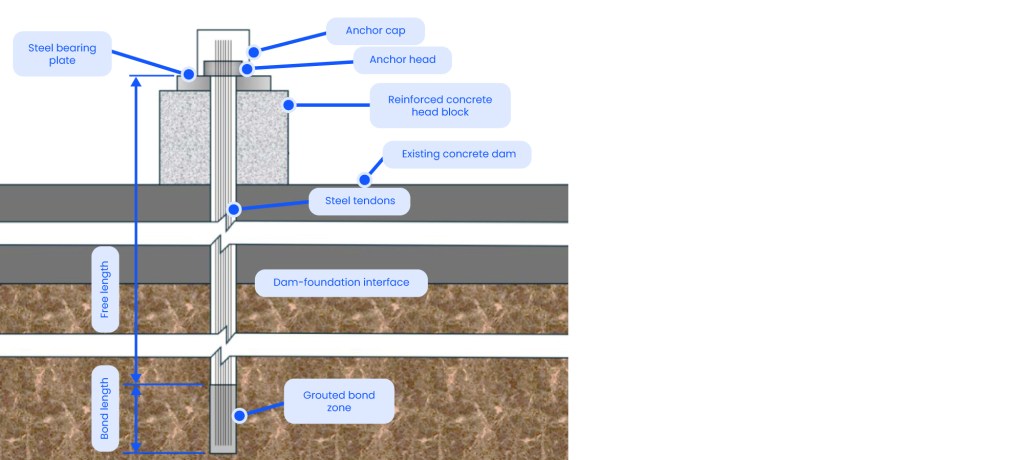
Typical post-tensioned anchor assembly showing how forces are transferred into existing dam-concrete
Head blocks are the critical interface between modern anchors and ageing concrete. They spread forces across a larger footprint, protecting the original structure. Choosing the right type of head block is therefore central to both safety and constructability.
SMEC’s study compared two contemporary head block types:
Each option has advantages depending on dam geometry, concrete condition and operational needs. Stress beams are straightforward to build above the surface, while cylindrical blocks are less intrusive and often easier to maintain.
To provide clear guidance, SMEC undertook a parametric study using advanced finite element analysis (FEA). By varying concrete strength, anchor spacing and proximity to the upstream face, the study produced practical design charts that simplify complexity and support early‑stage decisions.
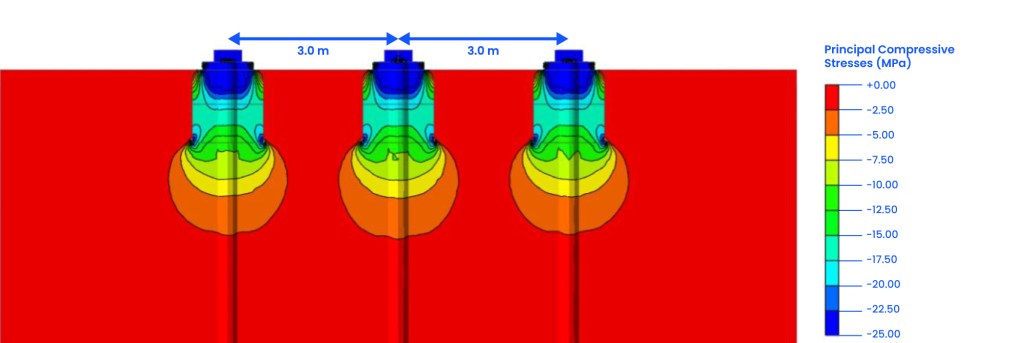
Principal compressive stresses long section – stress beam head block – 3.0 m spacing
These charts help answer key questions:
The findings show how modern analysis tools can validate designs, reduce risk and support more resilient upgrade strategies. By turning detailed modelling into practical guidance, SMEC equips dam owners and regulators with evidence‑based recommendations that inform feasibility and concept design.
SMEC continues to advance dam safety and resilience through innovative design and analysis. If you’d like to explore how these insights can support your projects, connect with our team to learn more about applying these approaches to real-world challenges.