
Mtentu Bridge – N2 Wild Coast Toll Road


From the early pioneers on the Snowy Mountains Hydroelectric Scheme, to our leaders and innovators of today, our people make us who we are.
Through our network of global specialists and by collaborating with local partners, we connect you with the best teams and capabilities to deliver highly innovative and sustainable solutions.
As an organisation we are continually evaluating ways we can better provide a safe, flexible, inclusive and respectful workplace for our people and clients.
People are at the heart of our organisation, we strive to create a flexible, diverse and inclusive environment that enables our people to thrive to their fullest potential.
Explore career opportunities
Rising 223 m above the Mtentu River valley in the Eastern Cape, it will become Africa’s tallest bridge and one of the continent’s longest main-span balanced cantilever bridges when complete. Forming a key part of SANRAL’s N2 Wild Coast Toll Road, the bridge will enhance regional connectivity between East London and the KwaZulu-Natal border, reducing travel times by up to three hours while stimulating local economies along the route.
Designed by a team under the HVA Joint Venture – comprising SMEC South Africa, CH2M (now Jacobs), and Axis – the bridge’s conception and design reflect decades of collaboration, innovation and detailed research. SMEC’s role spans project management, concept and detailed design, tender documentation and ongoing construction supervision. The design team included Dissing+Weitling (architectural design), Melis and Du Plessis (geotechnical services), Nyeleti (BBBEE design) and Dynacon (detailing), with specialist investigations commissioned from the Council for Geoscience for seismic loading and the Council for Scientific and Industrial Research (CSIR) for wind climate assessment. UK-based BMT Fluid Mechanics conducted wind-tunnel testing to simulate complex aerodynamic behaviour during operation.
During concept development, engineers faced the challenge of designing a bridge in a remote, environmentally sensitive valley with steep sides and variable topography. More than seven alignment options were evaluated, balancing geometric efficiency with minimal environmental disturbance. Vertical grades ranging from 4% to 6% were tested to optimise both structure and cost. Several structural systems were explored, including long-span cable-stayed arrangements of up to 480 m, a five-span cantilever configuration and hybrid solutions. The final design – a three-span balanced cantilever with incrementally launched approach spans – was chosen for its structural efficiency, constructability and aesthetic simplicity.
The completed bridge will measure approximately 1,133 m with a 260 m central span. The deck is a prestressed concrete box-girder, designed as a continuous structure with expansion joints only at the abutments to improve durability and reduce maintenance costs for SANRAL. The 22.8 m-wide deck carries four traffic lanes, shoulders and dual 1.4 m sidewalks, varying in depth from 15 m at the piers to 5 m at mid-span. The bridge’s approach spans are incrementally launched in 66 m sections, following vertical sag curves that blend seamlessly into the main spans’ consistent grade.
The main piers, soaring up to 148 m, are constructed as twin-bladed hollow box sections designed to withstand vertical and lateral forces from wind, seismic activity and temperature variations. These monolithic concrete piers rest on spread footings founded on competent rock strata. The foundations’ design was guided by specialist input from the Department of Geoscience and the CSIR, ensuring resilience under complex loading conditions. Extensive wind-tunnel testing confirmed turbulent vertical wind components in the valley, making aerodynamic stability a critical design factor.
Beyond its structural magnitude, the Mtentu Bridge exemplifies digital and sustainable engineering. Continuous internal access is provided through the full deck length, allowing safe maintenance and monitoring without external scaffolding or closures. The bridge incorporates an advanced Structural Health Monitoring System (SHMS) featuring over 100 marine-grade sensors that measure strain, displacement, vibration, temperature and wind load in real time. The system includes built-in power redundancy, lightning protection and automated control to ensure continuous operation. It is designed for long-term reliability, with technology upgrades planned every 25 years throughout the bridge’s 100-year lifespan.
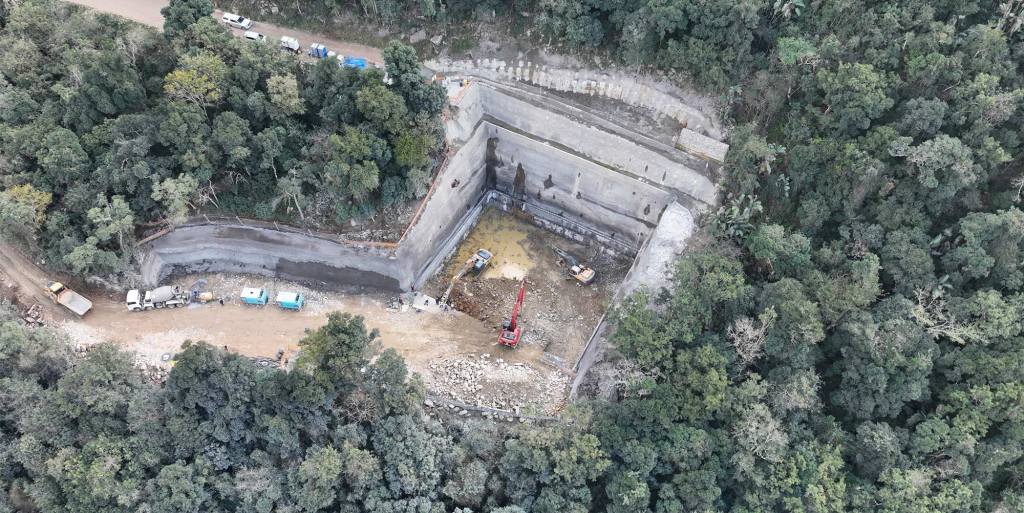
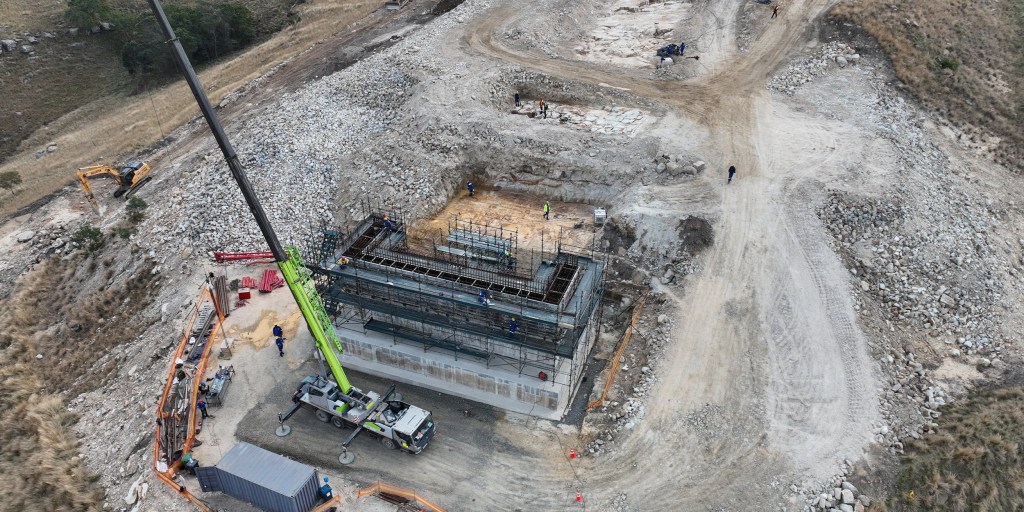 Abutment works where the Mtentu Bridge deck will tie into the approach roads, ensuring a seamless structural transition.
Construction, awarded to the China Communications Construction Company–MECSA Joint Venture, commenced in August 2023 following a four-month mobilisation period, with completion expected mid-2028. The contract includes not only the bridge but also 18 km of adjoining provincial road upgrades and new community access routes connecting Flagstaff and Mkhambati. The project is expected to create over 1,800 full-time equivalent jobs and inject more than R140 million into the regional economy through local labour and procurement.
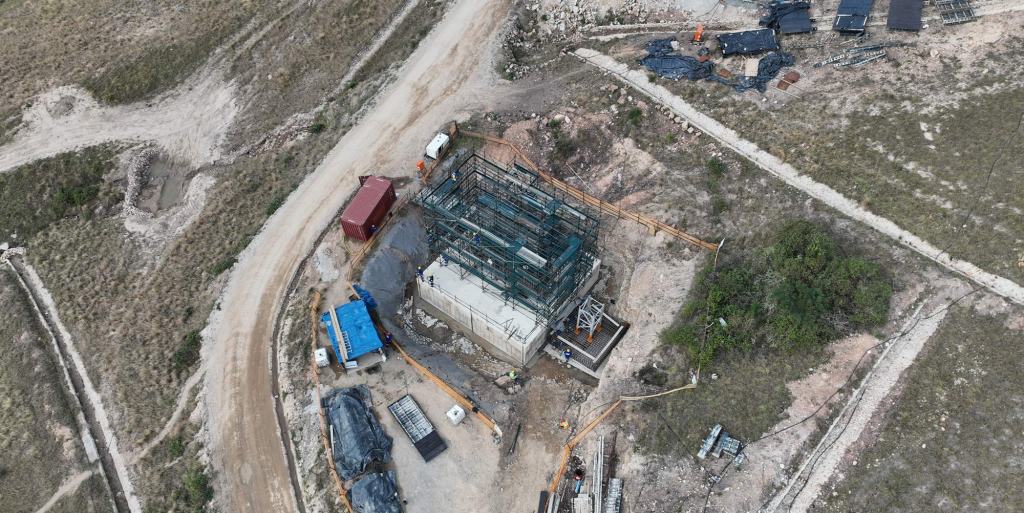 ILM pier under construction, forming part of the incremental launch approach.
Once complete, the Mtentu Bridge will not only stand as Africa’s highest bridge but also as a defining symbol of South Africa’s engineering capability. Its combination of structural complexity, environmental consideration and intelligent monitoring sets a new benchmark for large-scale infrastructure on the continent – and reaffirms SMEC’s role in delivering transformative, future-ready engineering solutions.