



Stockland Upfront Carbon Assessments


From the early pioneers on the Snowy Mountains Hydroelectric Scheme, to our leaders and innovators of today, our people make us who we are.
Through our network of global specialists and by collaborating with local partners, we connect you with the best teams and capabilities to deliver highly innovative and sustainable solutions.
As an organisation we are continually evaluating ways we can better provide a safe, flexible, inclusive and respectful workplace for our people and clients.
People are at the heart of our organisation, we strive to create a flexible, diverse and inclusive environment that enables our people to thrive to their fullest potential.
Explore career opportunities
In partnership with Robert Bird Group and Atelier Ten, SMEC is supporting Stockland by strengthening the methodology, tools and assessment process used to track project level carbon reductions across the development portfolio.
The work included review of Stockland’s upfront carbon methodology, providing a clearer reference point for tracking performance over time. SJ Group also refined the tools used to assess projects, including calculation logic, assumptions, emission factors and material categories.
This creates a more reliable way to compare projects, recognise recurring carbon drivers and carry lessons from completed work into future reduction planning.
Engineering judgement is central to the approach. Upfront carbon calculations are tested against practical project knowledge, helping interpret whether emissions are being influenced by material quantities, site constraints, technical requirements or delivery assumptions.
The reporting outputs translate detailed calculations into practical summaries, showing carbon intensity and emissions by lifecycle stage, project element and material category. This gives project and sustainability teams a clearer view of how embodied carbon differs between asset types and which parts of the project have the greatest influence on upfront carbon outcomes.
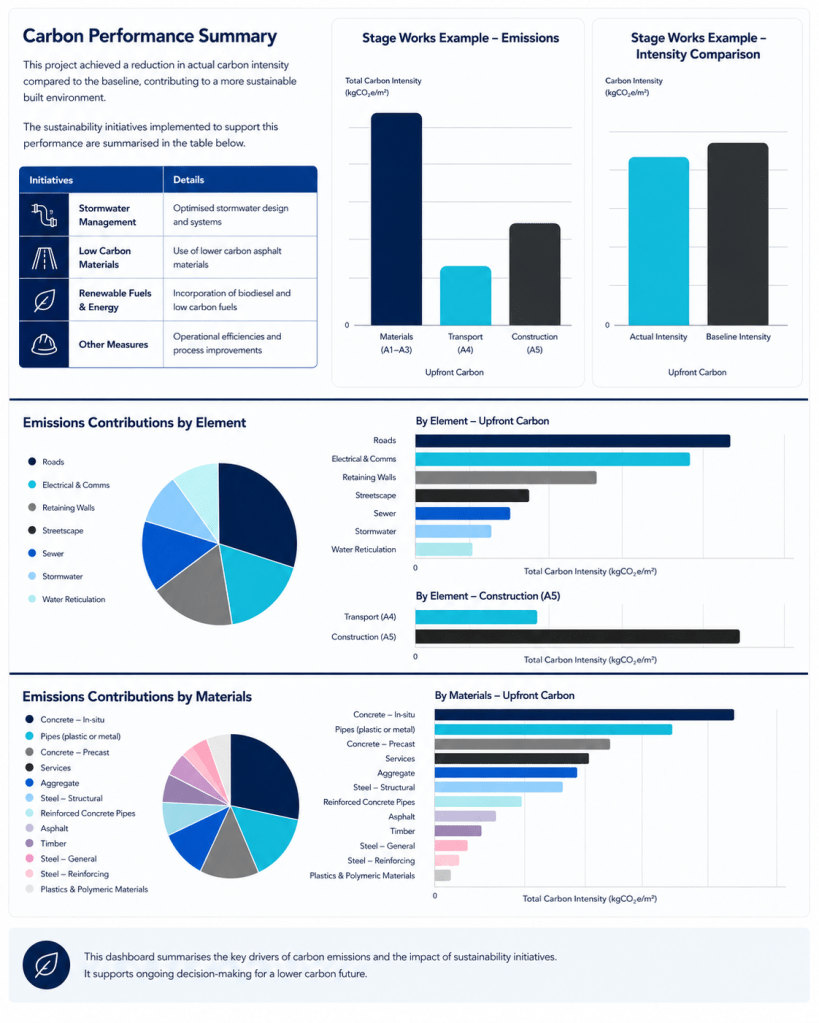
The work is helping Stockland develop a stronger evidence base for earlier decision-making.
By applying a robust carbon measurement approach across different parts of the portfolio, Stockland can utilise detailed data and insights to understand the embodied carbon profile of its development assets and identify where reduction opportunities are likely to have the greatest impact.
Completed-project assessments can now inform live project decisions while key choices remain open. This creates a practical feedback loop in which evidence from delivered work informs guidance that can be applied earlier on future projects.
For Stockland, the result is more credible, comparable and useful upfront carbon data to support reporting and reduction planning. For SJ Group, the work demonstrates how carbon advisory and practical engineering judgement can help clients turn carbon data into project-level insight.